
Your First $100 Investment: A Beginner’s Step-by-Step Plan
Yes, $100 is enough. Open a no-minimum brokerage account, put the money into a low-cost index fund or fractional ETF shares, and set up a small automatic deposit. That’s the whole plan. How to start...

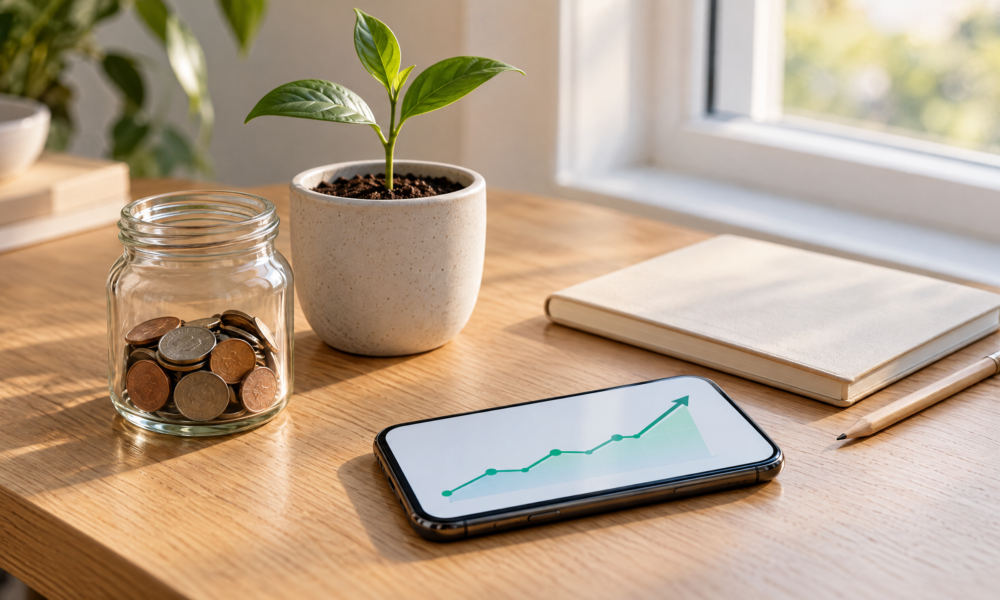
Yes, $100 is enough. Open a no-minimum brokerage account, put the money into a low-cost index fund or fractional ETF shares, and set up a small automatic deposit. That’s the whole plan.
Table Of Content
- Is $100 Enough to Start Investing?
- What Should You Do Before You Invest It?
- Where Should You Open Your First Investing Account?
- Fidelity, Schwab or Vanguard?
- Taxable Account or Roth IRA?
- Fractional Shares or ETFs: What Should You Buy?
- Quick Comparison
- How Do You Invest the $100, and What Comes After?
- What Can $100 Realistically Grow Into?
- Mistakes That Shrink a First Account
- Quick Answers Before You Go
- What’s the best thing to buy with $100?
- How do I start investing with $100 and no experience?
- Should I invest $100 or save it?
- Why does a small amount still matter?
- When should I add more money?
How to start investing with $100 refers to the process of opening a brokerage account, buying a low-cost fund or fractional shares with that money, and adding to it regularly. The goal isn’t to get rich on $100; it’s to build the habit and learn with little at risk.
This works best if you’re 18+, live in the US, and have no high-interest debt. It won’t help if you need the cash within a couple of years. This guide covers US brokerage accounts and the Roth IRA. It does NOT address crypto, options, or accounts outside the US. It’s education, not personalized financial advice.
Is $100 Enough to Start Investing?
$100 is enough to start investing, because major US brokers such as Fidelity and Schwab let you buy slices of a share with no account minimum. According to Gallup’s 2025 survey, only 28% of adults in households earning under $50,000 own stock, so plenty of people with modest budgets still haven’t begun.
It isn’t rocket science, you won’t need a finance degree, and you’ll learn most of it by doing.
Still, let’s be honest about the size. Left alone at a 7% yearly return, $100 becomes about $197 in ten years. Getting from $100 to $1,000 with no extra deposits takes about 35 years.
Money isn’t the point here. Reps are.
The best way to start investing with $100 is to open a no-minimum brokerage account, put the money into one low-cost, broad-market index fund, and then add a small amount on a schedule. Spreading your money across hundreds of companies in a single fund lowers the damage any one company can do to your balance.
What Should You Do Before You Invest It?
Before you invest your first $100, check three things: high-interest debt, a small emergency cushion, and whether you’ll need the money within a few years. According to the SEC’s Investor.gov, all investing involves risk, including losing some or all of what you put in, so money you can’t afford to lose belongs in savings first.
Look, if you’re carrying a credit card balance at 22%, here’s what actually works: send the $100 to the card. Guaranteed savings beat uncertain market returns, and many cards charge well over 20%.
Some experts argue you shouldn’t invest a dollar until you have three to six months of expenses saved. That’s valid for anyone with unstable income or dependents. But if you already hold a starter cushion of a few hundred dollars and no costly debt, investing $100 won’t wreck your safety net.
What most guides skip is the source of the money. Rent money, tuition money, and next month’s bills don’t qualify.
Where Should You Open Your First Investing Account?
Pick a broker that charges no commission, asks for no minimum, and sells fractional shares. Fidelity and Charles Schwab both fit, which is why they show up in most beginner guides. Don’t overthink it. Here’s the thing: the differences between them matter far less than actually opening one this week.
Fidelity, Schwab or Vanguard?
Fidelity has no account minimum and lets you buy fractional shares of stocks and ETFs from as little as $1. Schwab’s Stock Slices starts at $5, but it’s limited to S&P 500 companies, so you can’t use it to buy an ETF.
Vanguard is known for low-cost funds like VOO and VTI. One share of either costs several hundred dollars, though, and its mutual funds often carry larger minimums, so check current terms before choosing it for a $100 start.
Taxable Account or Roth IRA?
A regular brokerage account lets you withdraw anytime. Dividends and profits are taxed, and gains on investments held over a year generally get lower rates than gains on those sold sooner.
A Roth IRA is a retirement account. You can pull out your contributions (not the earnings) without tax or penalty, but you need earned income to contribute, and the yearly limit is set by the IRS.
Fractional Shares or ETFs: What Should You Buy?
A stock is a slice of one company. An ETF is a basket of many stocks you buy as one item, and it trades like a stock. A fractional share simply means buying part of a share, so $100 can go into something that costs $500 a piece.
Fractional shares vs ETFs: fractional shares are better suited for owning a slice of one company because you can buy $10 of a $500 stock. ETFs work better when you want instant diversification in one purchase. The key difference is that fractional shares are a way of buying, while an ETF is the thing you buy.
Here’s my take, and some readers will disagree: skip individual stocks with this first $100. Picking a company you love is more fun, but one bad earnings report can hit a single stock hard, and a fund holding hundreds of companies is much harder to knock over. Fun can wait for money you can afford to lose.
Quick Comparison
| Option | Best For | Key Benefit | Limitation |
|---|---|---|---|
| Fractional shares of one company | Owning a specific brand you believe in | Start with a few dollars | All your money rides on one business |
| Broad-market ETF (such as VTI) | Hands-off beginners | Hundreds of companies in one purchase | Needs a broker with fractional ETF shares at this budget |
| No-minimum index fund (such as Fidelity’s FZROX) | Automatic monthly investing | No minimum, easy recurring deposits | Held only at Fidelity; prices once a day |
| High-yield savings account | Money needed within about 3 years | No market risk | Interest may trail inflation |
Fund terms and rates change, so confirm them on the broker’s site.
How Do You Invest the $100, and What Comes After?
To invest your first $100, follow these steps:
- Open a no-minimum brokerage account at Fidelity or Schwab.
- Link your bank account and transfer $100.
- Search for a broad-market index fund or ETF.
- Enter $100 as the amount, then place the order.
- Set up a recurring deposit, even $10 a month.
One catch: bank transfers can take a few days to clear, so the purchase may not go through right away.
What Can $100 Realistically Grow Into?
I’ve seen conflicting data, some sources say stocks average around 10% a year, others say closer to 7%. My read is that the gap is mostly inflation, so 7% is the better planning number. The table below uses it, and real returns swing wildly from year to year and can be negative.
| Years | $100 Left Alone | $100 + $25 a Month | You Paid In (Monthly Plan) |
|---|---|---|---|
| 1 | about $107 | about $417 | $400 |
| 5 | about $140 | about $1,920 | $1,600 |
| 10 | about $197 | about $4,470 | $3,100 |
Hypothetical 7% effective annual return, deposits at month-end, before taxes. Not a promise.
With $25 a month you’d pass $1,000 in under three years. Most of that is your own deposits, though, not growth. The habit does the heavy lifting.
Most people assume small accounts get eaten alive by fees. The numbers say otherwise: at a 0.03% expense ratio, which is what VOO and VTI charge, $100 costs about three cents a year.
Mistakes That Shrink a First Account
- Chasing viral picks. A stock that’s trending on TikTok has usually already moved.
- Paying flat monthly fees. A $3–$5 app fee on a $100 balance eats 36–60% a year.
- Selling after a bad week. Selling locks in the drop.
Or maybe I should say it this way: the biggest mistake isn’t a bad pick, it’s quitting after a bad month.
Quick Answers Before You Go
What’s the best thing to buy with $100?
For most beginners, one low-cost broad-market index fund or ETF, such as a total-market or S&P 500 fund. It spreads your $100 across hundreds of companies instead of betting on one.
How do I start investing with $100 and no experience?
Open a no-minimum brokerage account, transfer the $100, buy one index fund or ETF, and set a small automatic deposit. The bank transfer may take a few days to clear.
Should I invest $100 or save it?
If you have no emergency cushion or you’re carrying credit card debt, save or pay debt first. If those are covered and you won’t need the money for years, investing makes sense.
Why does a small amount still matter?
Starting early lets returns compound and builds the investing habit. Your first $100 teaches you how accounts, orders and market swings feel while mistakes still cost very little.
When should I add more money?
Add whenever you can do it regularly, even $10 to $25 a month, once your emergency cushion is in place. A steady schedule beats waiting for the perfect moment or a market dip.





No Comment! Be the first one.